
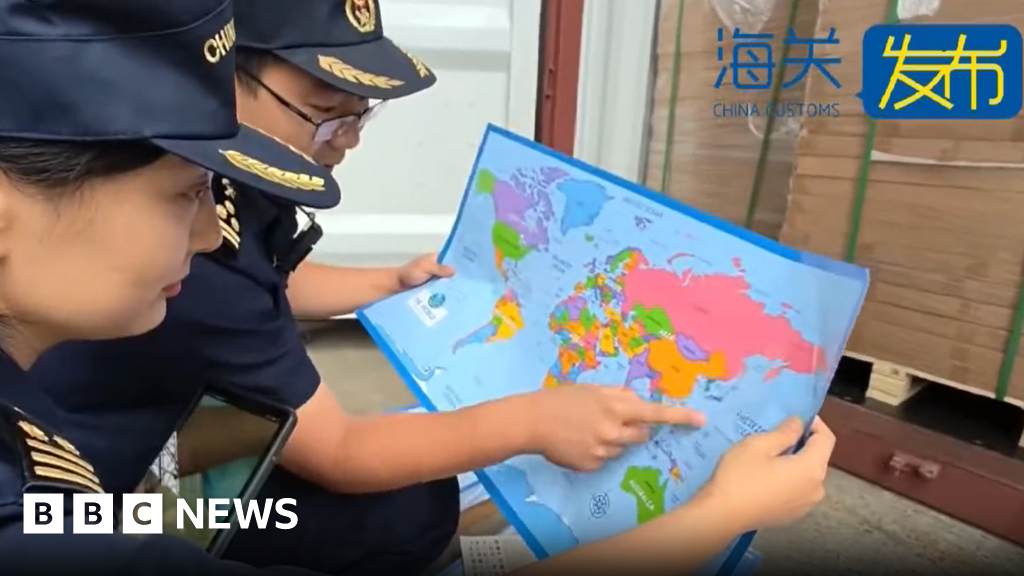
Chinese customs officers in Shandong province recently seized 60,000 maps that were said to mislabel the self-governed island of Taiwan, which is claimed by Beijing as part of its territory. The maps also excluded significant islands in the South China Sea, a region with overlapping territorial claims involving countries such as the Philippines and Vietnam.
Authorities indicated that these maps, intended for export, cannot be sold because they “endanger national unity, sovereignty, and territorial integrity.” Maps are considered a sensitive subject due to territorial disputes, particularly in the South China Sea.
According to China Customs, the seized items lacked the nine-dash line—a demarcation used by Beijing to assert its claims over nearly the entire South China Sea. The line stretches hundreds of miles from China’s southern province of Hainan. Additionally, the maps did not indicate the maritime boundary between China and Japan. Officials noted that the term “Taiwan province” was misrepresented, although specifics about the mislabeling were not disclosed.
Tensions related to Taiwan and the South China Sea are ongoing, with recent incidents including a reported confrontation between Chinese and Philippine vessels. Manila accused a Chinese ship of ramming a Philippine vessel, while China claimed the Philippine ship was approaching too closely despite warnings.
The South China Sea is a particularly contentious area for neighboring countries sensitive to its map depictions. For example, a recent movie featuring a map that included the nine-dash line faced a ban in Vietnam and censorship in the Philippines.
The specific destination of the seized maps remains unclear, but the confiscation of “problematic maps” by customs is not unusual in China. In evidence of this practice, customs officers previously seized nautical charts with inaccuracies in national borders and maps featuring incorrect representations of the Tibetan border.
Source: https://www.bbc.com/news/articles/czr1myxe673o?at_medium=RSS&at_campaign=rss