
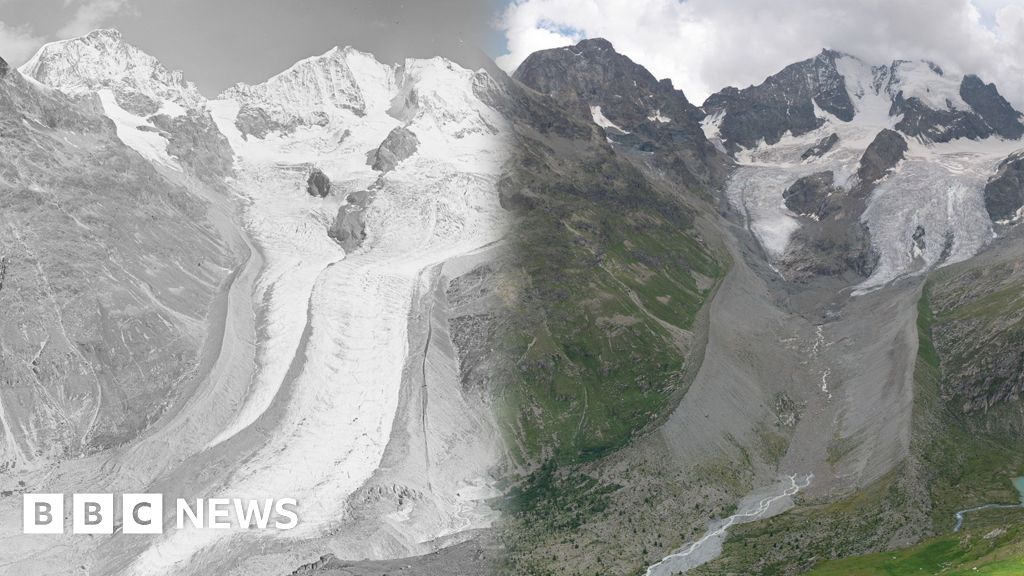
Glaciers around the world, particularly in Switzerland, are experiencing significant retreat due to climate change. Matthias Huss, the director of Glacier Monitoring in Switzerland, recalls that the Rhône Glacier was easily accessible 35 years ago but is now a half-hour walk from the parking area. Recent reports from the World Meteorological Organization indicate that glaciers outside of Greenland and Antarctica lost approximately 450 billion tonnes of ice in 2024 alone, a volume equivalent to a massive block of ice measuring 7 km on each side.
The rapid decline of glaciers is evident worldwide, with the Swiss glaciers particularly hard hit, having lost a quarter of their ice in the last decade. Prof. Ben Marzeion from the University of Bremen notes that glaciers are melting more rapidly in a climate increasingly hostile due to global warming. While glaciologists once considered a loss of 2% of ice per year as extreme, the reality is now much more severe, with losses nearing 6% documented in 2022.
The Clariden Glacier, for instance, had balanced gains and losses until the late 20th century but has since entered a phase of rapid melting. Smaller glaciers, like the Pizol Glacier, have completely disappeared. Historical photographs, including the Gries Glacier, reveal significant retreats over the past century, with glacial lakes forming where ice once stood.
Due to rising temperatures largely attributed to human activity, particularly carbon emissions, future glacier melt is expected to continue, regardless of immediate climate stabilization efforts. Research suggests that if global warming is limited to 1.5 degrees Celsius above pre-industrial levels, half of the remaining ice could be preserved. Current projections, however, suggest a potential warming of about 2.7 degrees Celsius, which could lead to significant ice loss and impact water resources for many communities, particularly in Asia where approximately 800 million people rely on glacier meltwater.
As glacial melting continues, it raises questions about the sustainability of water resources and impacts on ecosystems and human populations. The scientific community emphasizes the potential for mitigating these losses through reductions in carbon emissions.
Source: https://www.bbc.com/news/articles/ce32ezzq6zlo?at_medium=RSS&at_campaign=rss