
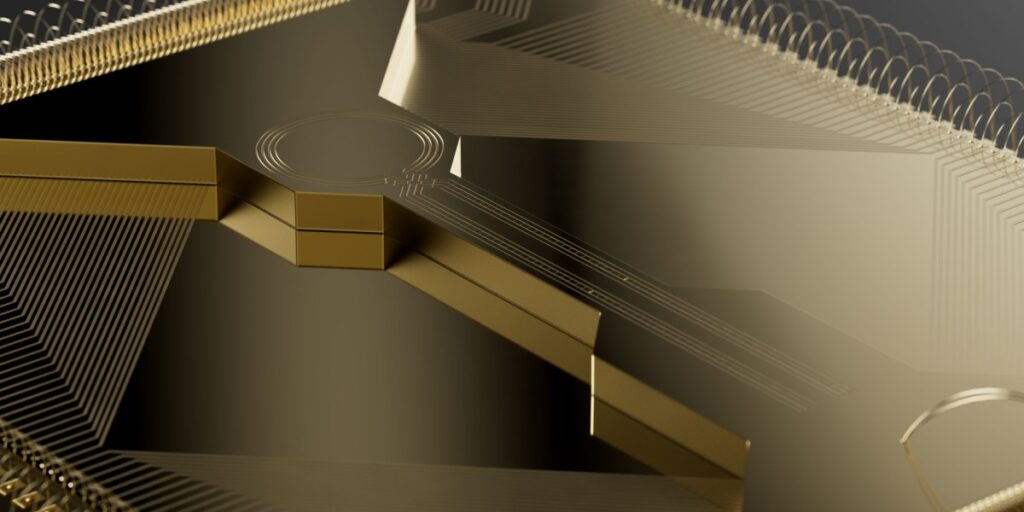
Quantinuum’s Helios quantum computer has gained attention for its precise qubit performance, which is highlighted by the low error rates it achieves. Rajibul Islam, a physicist at the University of Waterloo, notes that Helios allows qubits to interact effectively, demonstrating expected behavior in entanglement operations 99.921% of the time. This level of accuracy appears to be unmatched by other platforms.
The design of Helios, which employs ions, facilitates a feature known as “all-to-all connectivity.” Unlike superconducting circuits that are fixed in place, the mobility of ions on Helios enables comprehensive interaction among all qubits. This property contributes to more efficient error correction, requiring fewer physical qubits compared to superconducting systems, where interaction is limited to neighboring qubits.
As for future prospects in qubit technology, there is ongoing debate regarding which type of qubit will prove superior. While ions present some advantages due to their lower error rates, superconducting qubits are easier to produce, and neutral atoms, such as those used by QuEra, have simpler trapping mechanisms. Each technology has its merits regarding scalability and error management.
In addition to increasing qubit counts on its chip, Quantinuum has advanced its error correction capabilities, achieving “on the fly” corrections using Nvidia GPUs. David Hayes, the company’s director of computational theory and design, emphasizes the effectiveness of GPUs for this task compared to FPGAs commonly used in the industry.
Quantinuum has applied its technology to fundamental studies in magnetism and superconductivity, claiming that its simulations rival classical methods in understanding magnetic phenomena. The company plans to develop additional iterations of Helios and is working on a fourth-generation computer, Sol, expected for delivery in 2027, followed by the Apollo computer in 2029, which aims to provide thousands of fault-tolerant qubits.
Source: https://www.technologyreview.com/2025/11/05/1127659/a-new-ion-based-quantum-computer-makes-error-correction-simpler/