
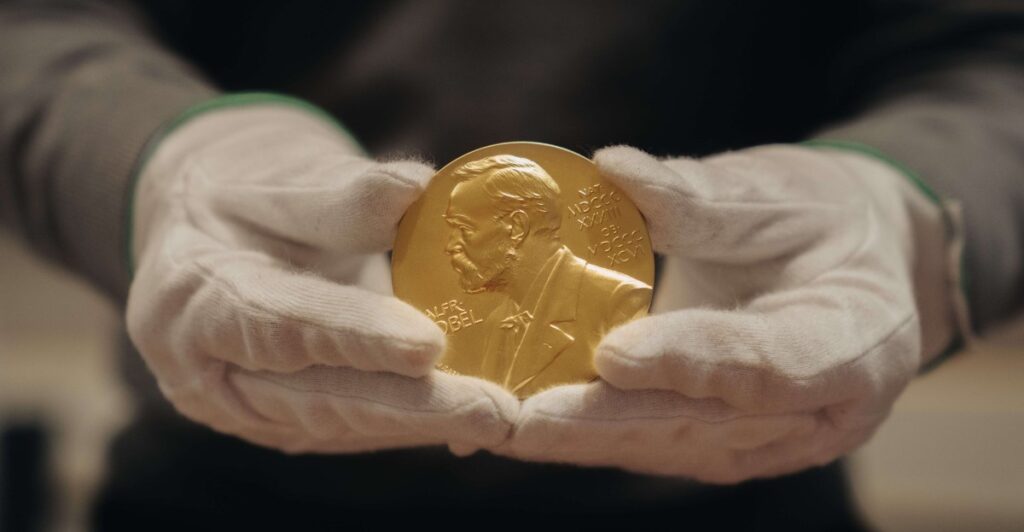
On Thursday, the 2025 Nobel Prize in Physics was awarded to three physicists: John Clarke, Michel Devoret, and John Martinis, recognized for their contributions to quantum mechanics in the 1980s. They developed a circuit that exhibited no electrical resistance, illustrating the concept of quantum tunneling. This phenomenon describes how atoms and subatomic particles can pass through barriers that they traditionally could not surmount.
Prior to their experiments, quantum tunneling was mostly theoretical. The successful demonstration of this effect in a physical circuit has been pivotal in the advancement of modern transistors and has contributed to the emerging field of quantum computing.
Clarke, in a phone interview following the Nobel ceremony, commented on the impact of their work on modern technology, such as cell phones, expressing surprise at receiving the award. He is currently an emeritus professor at the University of California, Berkeley, where he began his academic career in 1969. The foundational research conducted by Clarke, Devoret, and Martinis has been increasingly relevant in the context of contemporary quantum computing.
Both Devoret and Martinis have continued their work in the field at Google, focusing on quantum computing. In 2019, Martinis, then the hardware lead for Google’s Quantum AI team, announced the achievement of “quantum supremacy,” indicating a quantum computer’s ability to solve certain problems significantly faster than conventional supercomputers. Although Martinis has since left his position at Google, he remains a professor at Yale University and the University of California, Santa Barbara. Devoret currently serves as the chief scientist of quantum hardware at Google Quantum AI while also holding a professorship at the University of California, Santa Barbara.
The trio joins an elite group of physicists, including notable figures like Max Planck and Albert Einstein, who have received this prestigious award.
Source: https://www.theverge.com/news/795295/nobel-prize-phyics-quantum-computers