
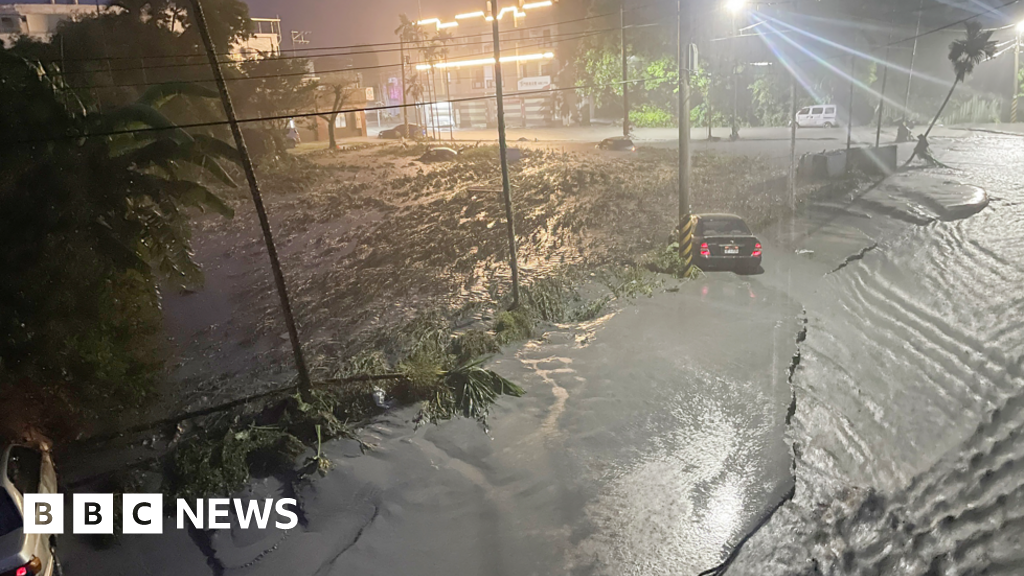
Two fatalities have been reported in eastern Taiwan, with many others either trapped or missing due to the impact of Super Typhoon Ragasa. This powerful storm caused a mountain lake to overflow in Hualien County, sending water into the township of Guangfu on Tuesday afternoon.
Rescue teams from various regions in Taiwan are mobilizing to assist. Ragasa is the strongest storm of 2025 and is now approaching China’s southern coast, where it is predicted to make landfall in Guangdong province on Wednesday. Consequently, around 370,000 individuals have been evacuated, and numerous schools and businesses have closed. Hong Kong has raised its typhoon warning to level 10, the highest classification.
The typhoon, measuring equivalent to a Category 5 hurricane, exhibited wind gusts nearing 285 km/h (177 mph) on Monday, prompting alerts for potential flooding, storm surges, and landslides throughout the area. Since Monday, Taiwan has experienced the outer bands of Ragasa, with reported rainfall exceeding 60 cm (24 inches) in the east.
In Hualien County, the inundation caused significant infrastructure damage, including the destruction of a bridge and the submergence of vehicles, with some areas experiencing water levels rising to the second floor of buildings. Approximately 263 individuals were moved to higher ground, according to officials, with no immediate danger reported as water levels began to recede.
In addition to these incidents, six injuries were recorded, with ferry services suspended and over 100 international flights cancelled. Warnings of storm surges reaching up to five meters have been issued in China, and residents in southern China and Hong Kong are preparing for potential impacts.
The path of Ragasa is expected to shift towards northern Vietnam in the upcoming days. As preparations continue, local authorities are warning residents to secure their homes and businesses against potential flooding and wind damage.
Source: https://www.bbc.com/news/articles/c3rvjj7dp7ro?at_medium=RSS&at_campaign=rss