
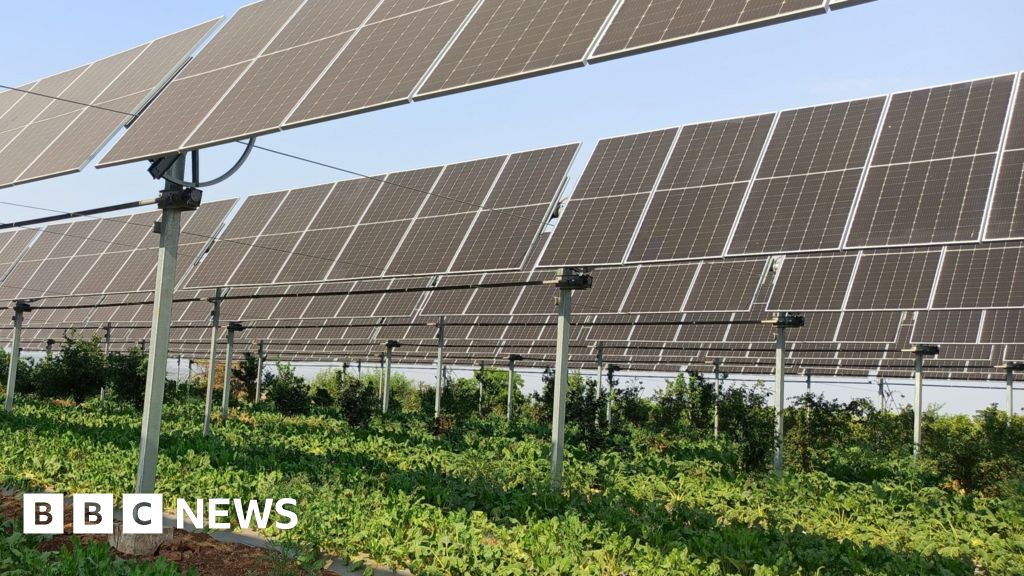
Harpal Dagar, a farmer near Delhi, has been involved in an agrivoltaics project for five years, where solar panels are installed above his fields. This arrangement allows him to farm underneath while generating a stable income from the solar operation. He entered a 25-year agreement with Sun Master, a solar power firm, which provides him with approximately $1,200 per acre annually, in addition to a maintenance payment of $170 per month.
Dagar notes that the challenges posed by unpredictable weather had previously impacted his crop yields. He expresses relief at the income stability the solar panels have provided, claiming his income has tripled since the partnership began. Agrivoltaics, the practice of utilizing land for both agriculture and solar energy, is seen as a potential solution to enhance agricultural resilience in regions vulnerable to climate change.
However, the adoption of such systems remains limited in India, with only around 40 projects operational across the country, according to the National Solar Energy Federation of India (NSEFI). Key obstacles include the fact that not all crops thrive under solar panels, with layouts that reduce sunlight by 15% to 30%, limiting options mainly to high-value crops like leafy vegetables and spices. The installation costs are also notably higher, due to the requirement that solar panels be elevated at least 11 feet to allow farming underneath, which presents a barrier for small farmers lacking sufficient capital.
Advocates for agrivoltaics propose that government intervention through subsidies could increase its viability. CEOs from various solar companies suggest that agrivoltaics could enhance income stability for farmers, especially in rain-fed, climate-vulnerable regions. However, concerns about contract enforcement and investment returns complicate the future of these projects in India.
Anand Jain, another farmer experimenting with agrivoltaics on 14 acres of land, reports a renewable energy generation capacity of 4.5 megawatts, indicating potential but also emphasizing that the model is not yet feasible for small-scale farmers without significant support from both the government and private sectors.
Source: https://www.bbc.com/news/articles/c2en1yyp4d9o?at_medium=RSS&at_campaign=rss