
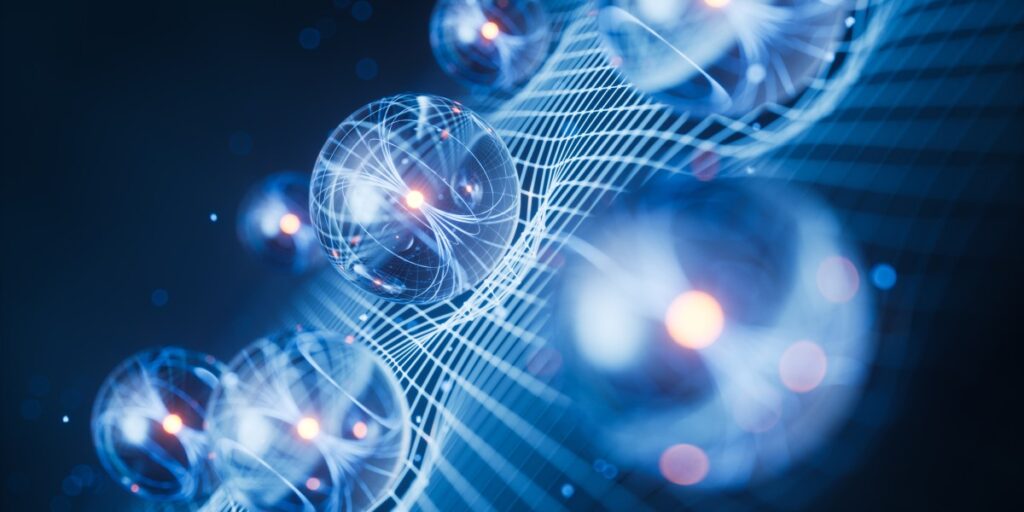
Nokia Bell Labs is pursuing advancements in quantum computing through the development of topological qubits, which are believed to offer greater stability compared to traditional qubits. Unlike conventional qubits that encode information with individual particles, topological qubits utilize the spatial orientation of matter to store information.
This method involves manipulating charges in a supercooled electron liquid using electromagnetic fields, allowing the qubits to transition between stable states over extended periods. According to Research Group Leader Michael Eggleston, the inherent stability of these qubits is significant; while traditional qubits can last mere milliseconds, topological qubits may retain states for several days.
The concept of topological qubits builds on scientific foundations established decades ago, notably the fractional quantum Hall (FQH) effect discovered by Bell Labs scientists Daniel Tsui and Horst Störmer, for which they received the Nobel Prize in Physics in 1998. However, the journey to developing topological qubits remains challenging, as much of the technology is uncharted territory.
Nokia Bell Labs has collaborated with other organizations, including Microsoft, to further research in this area. The team aims to demonstrate their ability to control topological qubits this year, switching them between states with enhanced stability. Eggleston indicates that achieving this milestone is crucial for developing quantum gating operations necessary for functional quantum computers.
If successful, topological qubits could transform the landscape of quantum computing, potentially yielding machines capable of solving complex optimization tasks and performing advanced simulations. This technology could have substantial implications for various fields, including chemistry and drug development, where it may enable faster and more intricate molecular modeling.
While the realization of a fully functional topological qubit remains a work in progress, its completion could unlock new capabilities in the quantum computing domain.
Source: https://www.technologyreview.com/2025/08/28/1121890/creating-a-qubit-fit-for-a-quantum-future/