
In the context of managing e-commerce platforms that process millions of transactions per minute, observability presents significant challenges due to the vast amounts of telemetry data generated by multiple microservices. When incidents occur, on-call engineers must sift through extensive data, making it difficult to extract relevant insights.
To address these challenges, a solution leveraging the Model Context Protocol (MCP) has been explored to enhance the observability of telemetry data. This article elaborates on an AI-powered observability platform designed to provide structured insights through a well-defined system architecture.
Observability is crucial in modern software systems, required for measuring and understanding system behaviors necessary for maintaining reliability and performance. However, achieving effective observability is complicated by the sheer volume of telemetry data generated by cloud-native architectures. Organizations, as reported by New Relic’s 2023 Observability Forecast Report, often struggle with siloed data, with only a minority achieving a unified view of their logs, metrics, and traces.
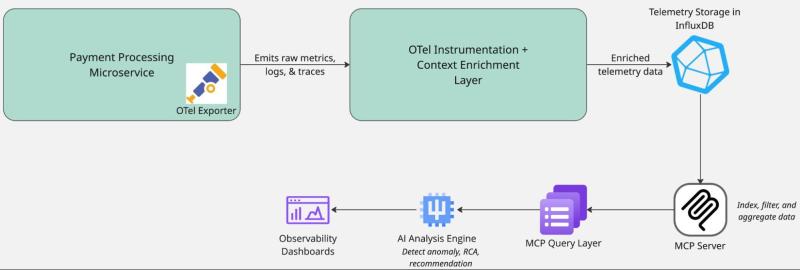
The MCP facilitates a structured data pipeline that includes contextual ETL for AI, a structured query interface, and semantic data enrichment. This design aims to shift observability from reactive problem solving to proactive insights. The system incorporates a layered architecture for contextual telemetry data generation, structured data access via the MCP server, and AI-driven analysis for detecting anomalies and determining root causes.
The implementation of this MCP-powered observability platform offers several advantages, including faster anomaly detection, improved root-cause identification, and reduced alert fatigue. The findings indicate that embedding contextual metadata during telemetry generation enhances data correlation and accessibility.
Overall, the integration of structured protocols like MCP with AI-driven analyses holds potential for transforming telemetry data into actionable insights. As the challenge of observability continues, adopting such innovative solutions could significantly improve the operational efficiency of engineering teams.
Source: https://venturebeat.com/ai/from-terabytes-to-insights-real-world-ai-obervability-architecture/