
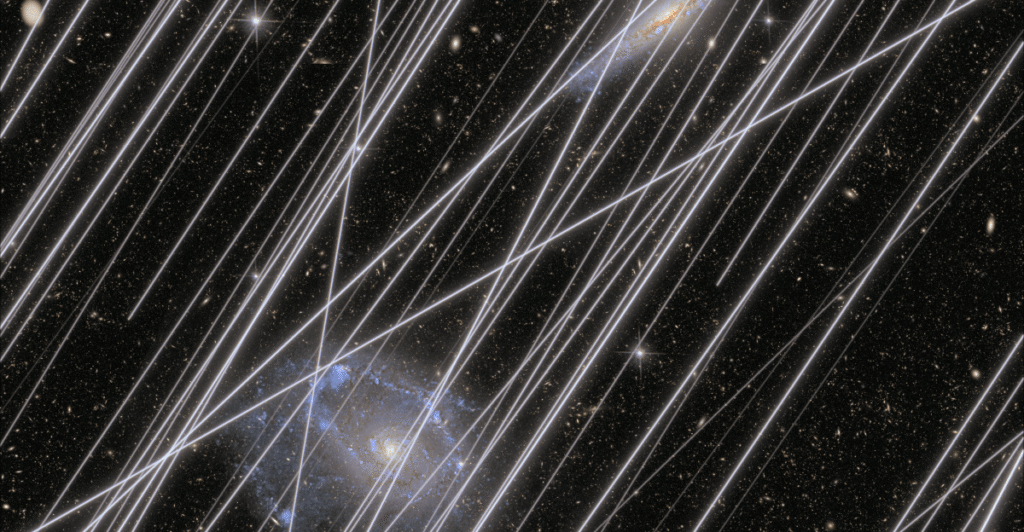
Recent research highlights the challenges faced by telescopes like Hubble due to the increasing number of satellites in Earth’s orbit. According to a study published in Nature by NASA researchers, satellite trails could disrupt nearly 40% of Hubble’s images and up to 96% of images from three other telescopes over the next decade.
This surge in satellite launches could hinder the ability of scientists to detect potentially hazardous asteroids or discover new planets. The problem is exacerbated by the need to manage light pollution stemming from new satellite megaconstellations.
Alejandro Borlaff, a NASA research scientist and the study’s lead author, noted the concern regarding future astronomical observations. The study revealed that satellite trails, already present in 4.3% of Hubble’s images between 2018 and 2021, may become a significant issue as the number of satellites increased from approximately 5,000 in 2019 to over 15,800 currently, with projections possibly reaching 560,000 within the next decade.
Simulations conducted by Borlaff and colleagues suggested that Hubble could capture an average of 2.14 satellites per exposure, while the Chinese Space Station Telescope Xuntian could encounter around 92. Despite a narrower field of view, Hubble might still face challenges, while other telescopes, like the James Webb Space Telescope, are positioned far enough to avoid much light interference.
The issue of satellites extends beyond mere visibility; the reflected light from these satellites can obscure essential details in images, potentially making it difficult to identify phenomena, such as changes in star brightness associated with exoplanets. Researchers advocate for exploring solutions to mitigate the problem before the satellite population grows further, which may involve coordinating satellite deployment with telescope operations and developing less reflective satellites.
Source: https://www.theverge.com/news/837652/hubble-telescope-satellite-light-pollution