
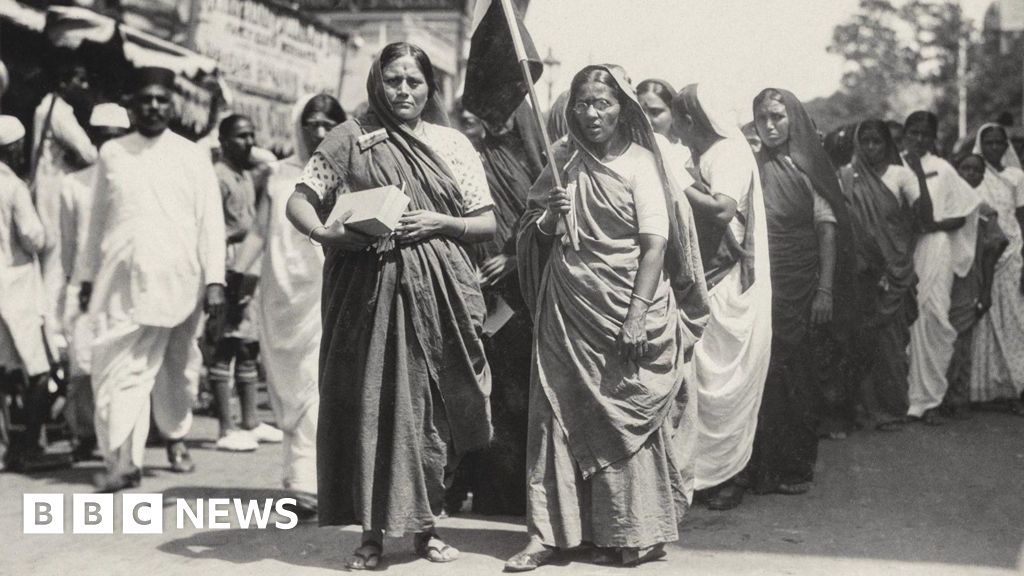
A newly surfaced collection of photographs is spotlighting the significant contribution of women in India’s civil disobedience movement, primarily led by Mahatma Gandhi between 1930 and 1931. These images not only document female participation but also illustrate how women took prominent roles in the political landscape, often overshadowing their male counterparts.
In April 1930, Gandhi completed a crucial salt march that challenged British salt production monopolies. Following this, he led various protests aimed at rallying the Indian National Congress’s supporters to create contraband salt and boycott foreign goods, as part of their push for complete independence, termed purna swaraj.
Historians recognize the civil disobedience movement as a pivotal instance in Indian political history. Although men were traditionally dominant in nationalist activities, women’s involvement grew significantly during this period. Initially, Gandhi restricted women’s participation in the salt march, but his position evolved after discussions with female leaders who argued for their inclusion.
The Alkazi Foundation in Delhi acquired one particular album containing these photographs from a London auction two decades ago. Despite its obscure origin and the incomplete captions provided in the album, it has recently gained scholarly attention. Historians discovered images capturing both the fervor of protests and the involvement of women, including footage of Lilavati Munshi, a Congress leader, engaging directly with police and participating in the boycott of British goods.
The album notably records instances that challenge traditional gender roles, showing women actively participating in protests and organizing actions. Researchers from Duke University, Sumathi Ramaswamy and Avrati Bhatnagar, emphasize that these photographs document a transformation in women’s roles, revealing their emergence as both leaders and active participants in public life.
The album’s impact is further amplified by the recent publication of a book titled Photographing Civil Disobedience, alongside ongoing museum exhibitions that acknowledge the key role women played in these historical movements. These efforts contribute to a broader understanding of women’s empowerment during a critical period in India’s struggle against colonial rule.
Source: https://www.bbc.com/news/articles/cr435zp7wy5o?at_medium=RSS&at_campaign=rss