
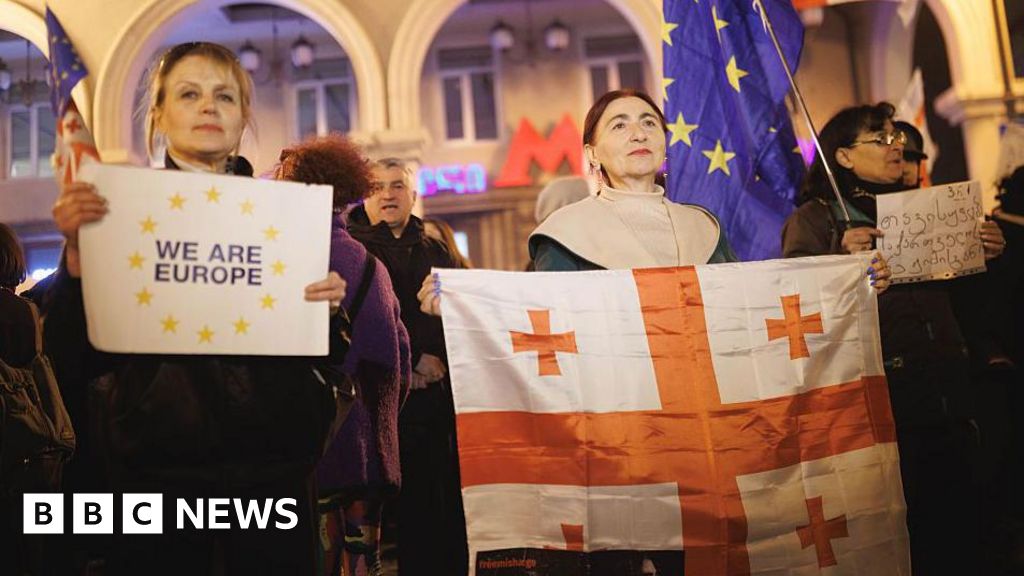
Protests in Georgia’s capital, Tbilisi, have continued for over a year, driven by discontent with the government’s decision to pause European Union membership efforts. Prime Minister Irakli Kobakhidze announced this four-year freeze on November 28, 2024, sparking mass demonstrations met with police crackdowns. Protesters express concerns about a regression in democracy and fear that Russian influence is growing in the region.
Participants in the protests, including individuals like Giorgi Arabuli, emphasize their commitment to a pro-European future, recalling the struggles of previous decades marked by civil war. The protests have evolved into nightly gatherings, often facing police opposition and new laws enforcing roadblocks and heavy fines.
Laws implemented by the ruling Georgian Dream party have increased penalties for demonstrators, including criminal charges against young activists. Notably, six prominent opposition leaders were jailed after refusing to testify regarding past government actions. Reports indicate that these leaders face serious charges, such as alleged sabotage.
Despite the opposition’s claims, the government maintains that its relationship with Russia is pragmatic and aimed at sustaining peace. However, many citizens see the government’s actions as aligning more closely with Russian interests, particularly given its founder’s background and the passage of laws reminiscent of Russian legislation targeting civil society.
The EU’s annual report on Georgia described the nation as an EU candidate “in name only,” stating that it is not on track for membership. The government’s response to this criticism has been increasingly hostile, with officials accusing the EU of imposing undesirable political ideologies.
In recent months, the Georgian government has introduced reforms affecting the education sector, aiming to centralize and streamline higher education but raising concerns about political interference and control. Activists worry that these changes will further suppress dissent and promote an autocratic governance model, distancing the country from its European aspirations. As protests persist, many participants seek to highlight the struggle for democracy and the implications of regional conflicts, notably the situation in Ukraine.
Source: https://www.bbc.com/news/articles/c208w378gg7o?at_medium=RSS&at_campaign=rss