
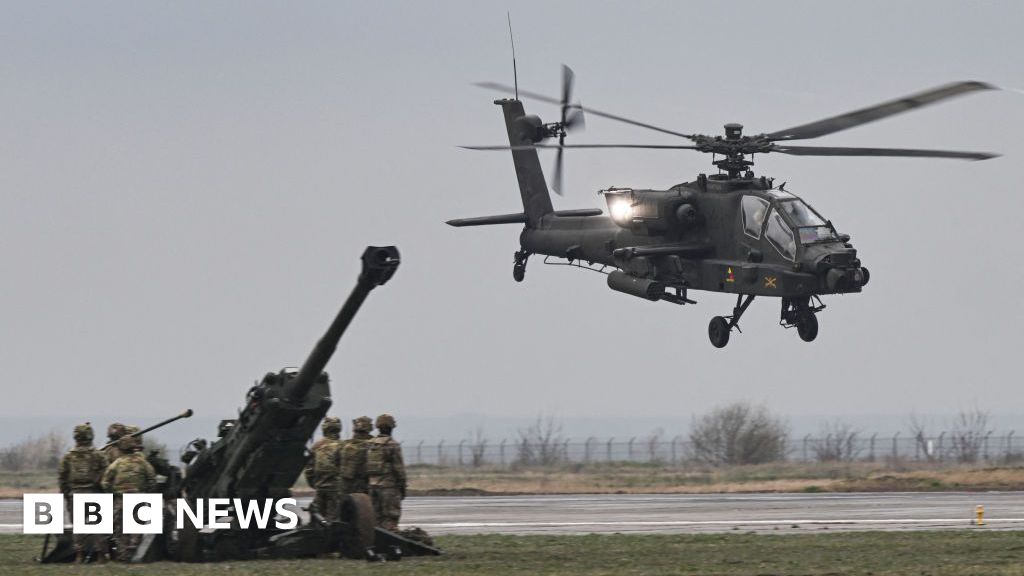
Romania’s defense ministry has announced that the United States plans to reduce the number of troops stationed in Romania, part of NATO’s eastern flank. The number of American troops will decrease from approximately 1,700 to between 900 and 1,000. This decision was characterized by the ministry as anticipated, linking it to the changing priorities of the Trump presidential administration.
Defense Minister Ionut Mosteanu relayed that U.S. Defense Secretary Pete Hegseth indicated to European allies the necessity of enhancing their own defense capabilities while the U.S. shifts its focus towards the Indo-Pacific region. A U.S. brigade that has been stationed at Mihai Kogalniceanu airbase, projected to be NATO’s largest in Europe, will be rotated out without a replacement. This brigade has components located in Bulgaria, Romania, Slovakia, and Hungary, but it remains unclear if troop levels in those countries will also be affected.
Polish Defense Minister Wladyslaw Kosiniak-Kamysz stated that Warsaw had not received any information regarding a potential reduction of U.S. troops present in Poland. Furthermore, Mosteanu confirmed that U.S. troop presence at Romania’s Deveselu and Campia Turzii bases will remain unchanged.
Since assuming office, President Trump has expressed a desire to realign U.S. military commitments from Europe to the Indo-Pacific, advocating for greater defense responsibility among European NATO members. While some Eastern European nations might view the troop withdrawal with apprehension due to concerns over potential Russian aggression, a NATO official reiterated that Washington’s commitment to the alliance remains strong and noted that troop adjustments are not uncommon. Currently, over 100,000 U.S. military personnel are deployed in Europe. The recent announcement from NATO about establishing the Eastern Sentry mission aims to bolster vigilance along the eastern flank in response to rising tensions, including recent incursions of Russian drones into Polish and Romanian airspace.
Source: https://www.bbc.com/news/articles/c8670d9xq32o?at_medium=RSS&at_campaign=rss